
Part 3 (of many) . . . Links to: Part 1 .. Part 2.
In Part 1 we noted the review of The Mikado in the Stanford Daily was written by an aficionado of the show but we don’t know who wrote it. In Part 2 the poor layout was covered, almost like it was made in a hurry or under duress. In part 3 we discuss something else on the page.
You would think one would just scour every inch of paper when doing something like this, but that opinion has the benefit of hindsight. I focused for weeks on the Mikado review before I ever really looked at the rest of the page, the TOP of page four in the October 31, 1969, Stanford Daily.
When I did look, I found it was a bunch of music reviews, with the first album review being Douglas Leedy’s The Electric Zodiac. Now that’s a funny coincidence, I thought.
But there’s more.
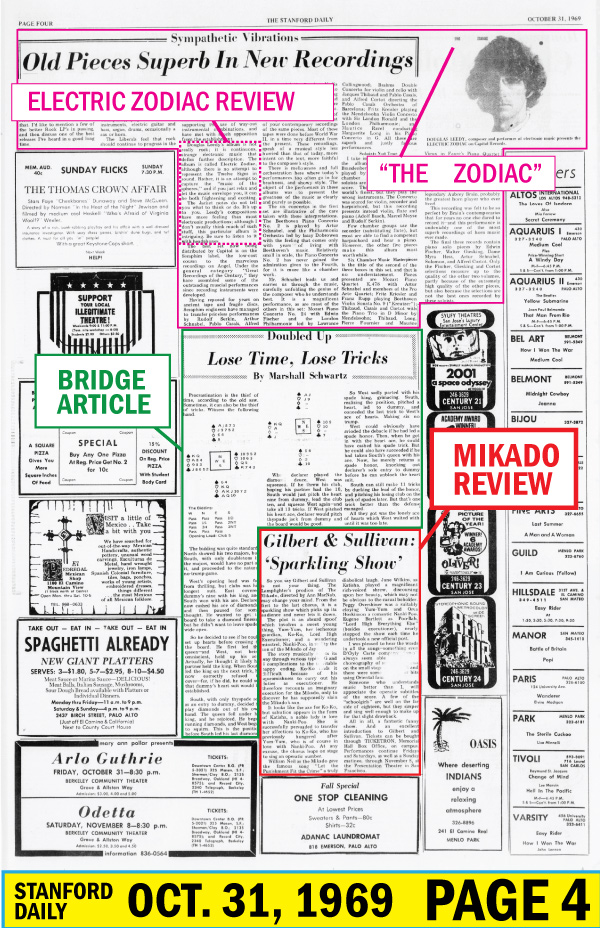
At the top of the page, there was a photo of the album cover of The Electric Zodiac. It was a headshot of the artist, Douglas Leedy. In the top left of the album, in small sixties type were the words, “The Zodiac.”
I blinked a few times.
Now the review clearly states the album’s name was The Electric Zodiac. I took to the internet and found another picture of the album online, and it does indeed say “The Electric Zodiac.” But in the photo in the Stanford Daily, the word “Electric” is missing.
I was stunned. I heard that weird music again. The hair on the back of my neck went up. Again. I don’t know about you, but I call that a coincidence. An amazing coincidence. A relatively larger F of a Coincidence than your normal F. (I know I’m in the wrong Act of this book, but it is, truly, an amazing coincidence.)
“This is getting ridiculous.” I said.
I can understand that the idea of the perpetrator laying out their own Mikado review in a Stanford student newspaper might be hard to accept, but now I had this other Zodiac coincidence on the same page.
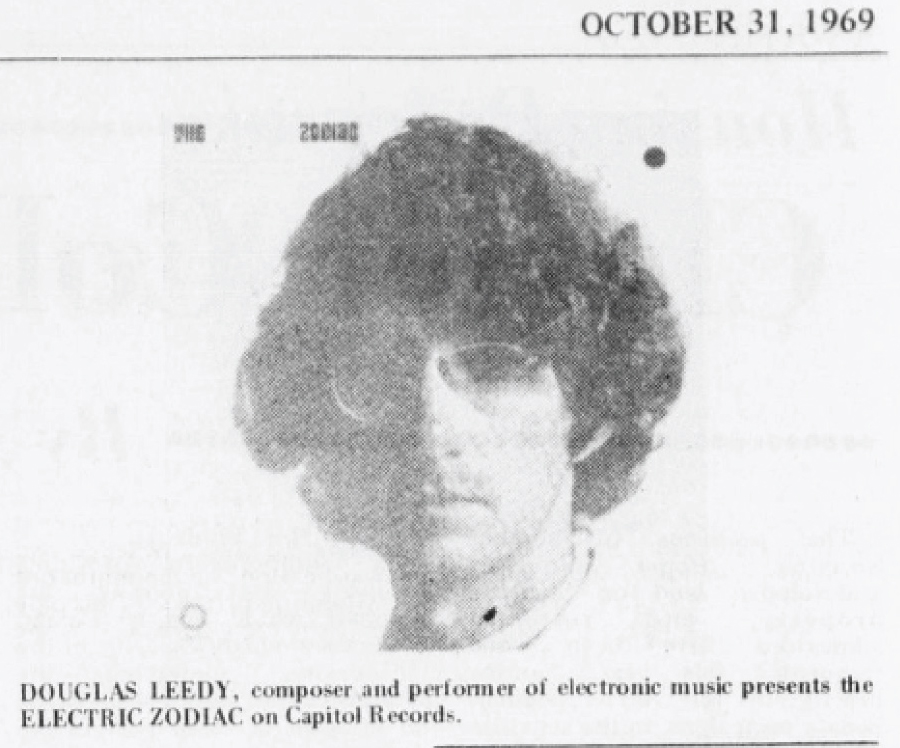
I wondered about someone whiting out the word Electric. But I realized there is another possibility. In the color photos of the album, I saw the word Electric was cyan (light blue). Light cyan was a color used in print production layouts in those days with lines that helped the artists keep the layouts aligned, but did not show up in the final printing. Anything light blue would go white. It’s possible the cyan text disappeared by this process.
Layout artists are well aware of this. In fact, a newspaper that knew it would be running a photo in black and white that contained a lot of cyan color would certainly have it photographed in black and white, known in the industry as “greyscale,” ahead of time. Then that greyscale photo would be “screened,” meaning turned into a series of discreet black dots that can be printed. This is how all black-ink photos are printed in newspapers and magazines, then and now. But if the color photo was screened directly to black and white, it is possible the cyan color might disappear.

The thing is, even though this could account for the word Electric disappearing, it is still entirely possible, even likely, that the person laying out this page or processing the photo knew very well that a color photo of the album placed in the layout would result in “Electric” failing to print, leaving just “The Zodiac.” It is almost certain that is indeed what occurred.
However it happened, by plan or by coincidence, this appears on the same page as the Mikado review in the Halloween 1969 Stanford Daily.
If it was on purpose, somebody thought it was funny as hell. Could it be “just a coincidence?”
Link to Oct. 31, 1969, page 4 in the Stanford Daily Archives.
Except from the book, pages 284-285. Stay tuned for Part 4.
 The Only Time Richard Got Angry at Me
Leave a comment