
Part 4 (of many) . . . Links to: Part 1 .. Part 2 .. Part 3
To review where we are at:
- The Mikado review in the Stanford Daily was written by an aficionado of the show’ but we don’t know who wrote it.
- The review has many layout mistakes, cut off letters, bad spacing, and white blemishes on each of the article’s two columns; almost like it was made in a hurry or under duress.
- It shares the page with a review for an album named “The Electric Zodiac” but in the photo “Electric” is missing, leaving just “The Zodiac.”
So, an uncreditted review for the Lamplighter’s production of The Mikado was really no big deal. And so what if it was poorly laid out, some of the poorest layout seen in any Daily across many issues and years? But fnding the words “The Zodiac” on the same page as this Mikado review in the Halloween, 1969 Stanford Daily made me realize that I now needed to look at every page in every Daily issue of this period MUCH more closely.
I reconsidered the white spots (blemishes) on the Mikado review. Could there be any significance or coincidence regarding them? There were two on the Mikado review, one on each column of the article. I conjectured perhaps the copy had not been waxed down on the layout board adequately and had bubbled up, causing the defect, or something like that. Others has posited these were defects caused by the scanner. It was true I was looking at digital versions from the Stanford Daily archive, not the original paper.
After some time, I discovered that page three of this issue also had spots, two on the bottom center of the page, and another very pronounced spot somewhat above them. Three spots. The newly discovered top spot was across two articles both with coincidental, or comic, value. One was an editorial from the Radical Libertarian Alliance, a group who help meetings in the Chaparral office that I had a hunch Richard would have been interested in, and the second titled “The Dolly is Dead.” “Dollies” are what Stanford calls cheerleaders.
I noticed that the bottom two spots on this page were in a very similar position to the spots on page four, the Mikado review page. I looked at page four again and it was true, the spots looked similar. But there seemed to be no third spot. But I looked closer and the upper spot was indeed there. It had been hidden because it was in a mostly white area on the page, in the midst of an article about Bridge. All three spots were on both sides of the paper! This spurred conjecture.
I took screenshots of all of these pages and stitched them together. I imported both pages into Photoshop and aligned them, flipping page three horizontally, as it would be on the back side of the paper of page four. Putting each page on a separate layer showed my conjecture was correct: Indeed, the spots aligned exactly!
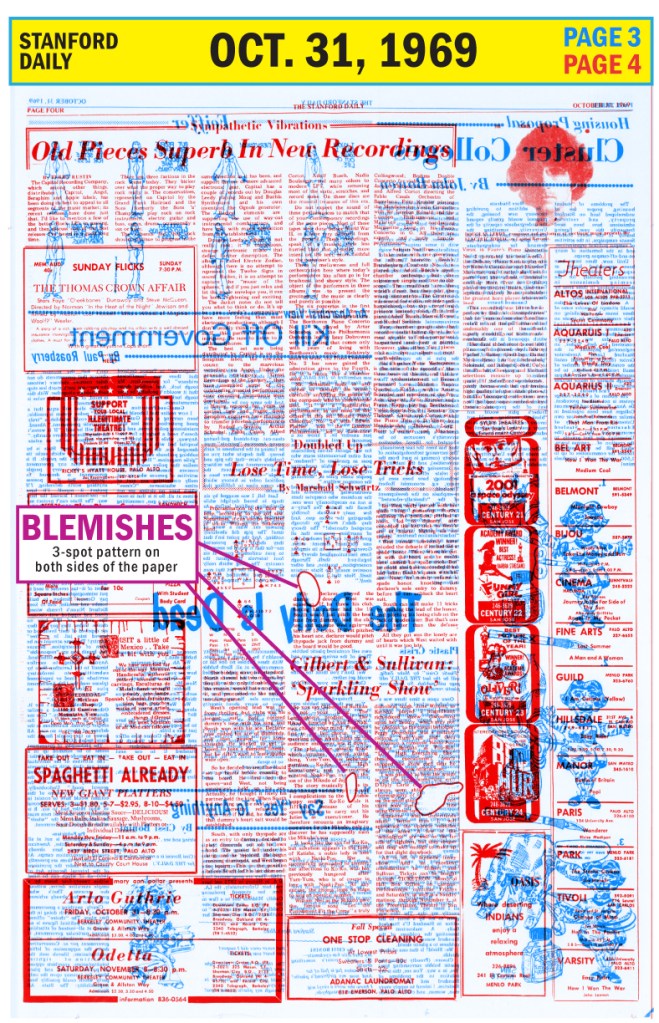
Links to the pages in the Oct. 31, 1969, Stanford Daily: Page 3 — Page 4
So what causes marks on both sides of the paper? This was no “scanning defect.” It appeared to me that someone poured something on the page that caused the ink to dissolve, and it bled through to the page on the back of the paper. I mean, how could there be this defect on both sides of the same paper if it were not for a solvent on the printed page, dissolving the ink and bleeding through to the page printed on the back side?
If true, this would mean that someone modified the actual copy of the paper that had been scanned for the archive, likely a bound volume. And if that were true, it would be a second instance of someone modifying the archival records of a Stanford student publication. I had already discovered the Chaparral’s archives had been modified–someone had inserted the fake “Missing Link” issue into them. Here we apparently have another instance of archive pranking.
I heard the eerie music in my head again. If someone had intentionally poured a solvent on the Mikado article, that would be a strange coincidence. What on earth could be the reasons someone would do that? If it wasn’t ‘just a coincidence” then this would be very interesting indeed. Very.
I continued to closely examine the issue. The spots seemed definitely bigger on the Mikado review on page 4 than those on page 3, so I figured the solvent was poured there. It had had apparently bled down through the paper on to page 3.
I wondered if they bled past page three and onto page two…
Stay tuned for Pt 5 tomorrow.
Links to: Part 1 .. Part 2 .. Part 3
The Only TIme Richard Got Angry at Me Amazon Paperback – Ebook
 The Only Time Richard Got Angry at Me
Leave a comment