
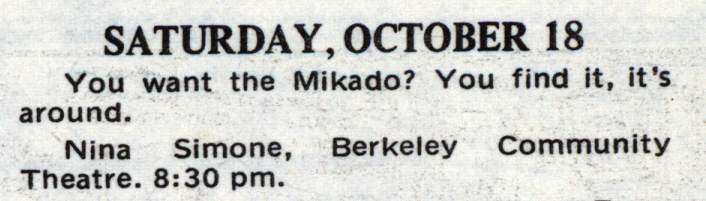
“You want Mikado? You find it, it’s around.” I kept thinking about this listing in the October 9, 1969 Stanford Chaparral, and always came back to the same thing: They had to pay for this to be typeset. Someone had to write it up, submit it to the ASSU typesetting shop, and it was added on the bill. Why no time and place? Why the attitude? What is the joke?
Apparently somebody wanted some Mikado.
Perhaps they wanted to put some Mikado in the Chaparral?
The listing reads, “You want Mikado? You find it. It’s around.”
So I went looking.
Of course, in October 1969, no one knew to look for Mikado-Zodiac coincidences. It would be a year before the public knew Zodiac liked The Mikado. The issues of the Stanford Daily passed into history unnoticed.
Here is the kicker—a point I did not understand until much closer examination of all of this: Zodiac REALLY liked the Mikado.
Regarding that October 9, 1969, Chaparral issue, I think someone must have asked about including a Mikado listing, but for whatever reason, the staff, or just the person doing the listings, did not want to do it. It’s not a question of location, there are plenty of San Francisco listings. It’s not a question of genre, they have the listing for the opera La Boheme, as well as the Grand Kabuki listings. Why on earth did they not just list the details for The Mikado?
Then there is the wording of the listing. It’s sarcastic. It’s dismissive.
I am VERY familiar with Chaparral editorial processes, and the culture of Chappies. It sure looks like someone was annoyed with someone else, and it made it into print. The “you” in the listing is not the collective you, it is a specific person.
And whoever this person was who was interested in The Mikado, they were persistent. I mean, a single request, a single mention would not result in the sarcastic listing that got printed. I think someone brought up Mikado multiple times, and for whatever reason, the staff was like, FU. I mean, why even bother printing this without the time and address if it was not some kind of joke pushback?
The Chaparral does indeed run joke listings, so this Mikado line is not completely out of nowhere. For example, in that same issue, the final listing for October 11 is Belly Dancing: Ken Pitzer & his Trained Seals, top of Hoover Tower, 1 am. The key question is this: What pushed the staff to have the FU response? You don’t go to FU over trivial matters, it had to be FU-worthy. What on earth could be FU-worthy about the Mikado? Perpetual requests about it would be one way.
I think maybe the listing was even a fallback request, after a proposal for a feature article was shot down–someone still wanted at least a listing. Maybe everyone was sick of hearing about the Mikado by then.
Here’s the deal: Each new issue of a magazine like the Chaparral begins with a germ session, staff members meet to suggest ideas and exchange information. They modify the ideas and decide what will go in the issue. The theme and cover story are also determined in a germ session with the editor having final say.
I remember them well, some of the most fun experiences of my life. Wild. Raucous. Drunken. Hilarious. Free flow of ideas, people spouting wit and sarcasm and puns in real time. Others struggling to get it all written on the chalkboard or notebook. This is exactly the process that the Who Shot R.R.? article and issue were born.
Of course we were doing comedy issues, but the political tabloid issues would have similar meetings where the plan of the issue came together. Article ideas, who to lambast, who to protest, what sarcastic cartoon to draw, whose cause to champion, where to get drugs, what was hip?
For the issue in question, everyone was psyched for the upcoming October 15 Vietnam Moratorium. It was a very exciting and important moment for the protest movement—it was going nationwide! There were lots of angles, and lots of stories worth writing about.
It was also early in the quarter, and they were still flush with dough, so there would be lots of people who wanted their article or artwork put in. The issue would be 24 pages, and there was a fair number of ads. All these factors make it very likely there was more content than there were pages to put it on.
I conjecture that someone in one of these germ sessions suggested that they do a feature, or at least a review, on the Mikado production going on up in San Francisco. I further conjecture that this idea was viewed as “Squaresville” to at least some significant proportion of the staff. I mean, there were important things at hand. The Moratorium would be six days after this issue—making it of extreme importance for getting the word out. This was a huge nationwide protest, predictions proved true that it was the day Vietnam protests went mass. The Mikado? A British opera from the 1800s about Japan? Sounds establishment, colonial. Were they really going to use their precious pages on that?
If this conjecture is correct, it’s quite possible the guy already had the feature written, or at least the Lamplighter’s press release, with photos or graphics. Do you think it focused on The Grand Executioner, or the Little List song? It’s possible.
When it was not accepted for publication, of course that was disappointing. Perhaps he even said something about it, or offered to shorten it, but it still wasn’t going in. Perhaps he just kept asking and the answer was still no. Perhaps he then tried to get a listing of the performance in the events in the back of the Chaparral.
Apparently, however it went down, it became a thing or a joke for some portion of the Chaparral staff. Anyone who is a Chappie, or worked on a publication, especially a glib, sarcastic one, knows about inside jokes, knows about paste-up hi-jinks. This is my conjecture explaining the October 9, 1969 Chaparral, listing: You want Mikado? You find it, it’s around.
Realize that someone actually had to order those words to be typeset. Someone had to type it up on a typewriter, send it to the typesetting office, and pay for it. The need for sarcasm was so great, that they went to the trouble of printing it in the issue, while NOT printing a time and place. It’s a retort. It’s mocking someone.
It’s making fun of someone who REALLY wanted something about Mikado in that October 1969 Stanford Chaparral, because the show was one of his favorites, and could provide a prank perhaps greater and more sophisticated than even the Dick Tracy gag. An appearance of Mikado’s Grand Executioner would bring the house down.
If he couldn’t get a Mikado article in the Chaparral, no matter. Maybe he could get something in the Daily?
 The Only Time Richard Got Angry at Me
Leave a comment