
David Levine, September 11, 1973 – COLD CASE
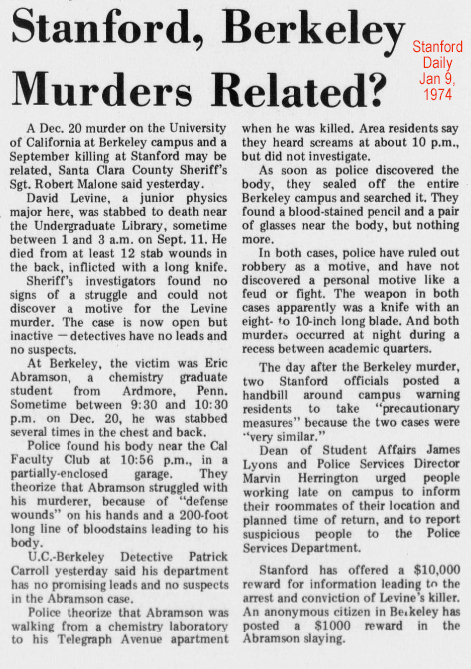
In the early hours of September 11, 1973, undergraduate student David Levine was murdered, stabbed approximately 15 times near Meyer Undergraduate Library on the campus of Stanford.
David Levine was a physics major from Ithaca, New York, the son of a Cornell professor. He was a standout student, and by all accounts, a brilliant, energetic and empathetic person. He was the star undergraduate of the Stanford Physics Department and was described by friends as someone who loved to discuss and debate politics for hours on end in the dorm lounge. He was on track to graduate in just three years and was doing work normally reserved for graduate students. He was working on a device that would be an alternative to an electrocardiograph. And because computers were scarce at the time, he was building his own computer.
An incoming freshman in the fall of 1971, he ran and was elected a student senator in fall of 1972. But his main focus was academics. He decided to stay on campus and attended summer session in 1973. Summer Quarter at Stanford ends in early August, yet he still stayed on campus to work on his project. Early September is one of the most deserted times on campus, save for workers and others preparing for the fall term that begins near the end of the month.
Levine left his lab and was presumably heading back to Mirrielees House where he lived. Levine’s wallet was empty, but intact, so the motive for his attack was not robbery. Police said they believed it was a surprise attack because there was no sign of struggle.
The site of the murder is one I am very familiar with, having lived on that side of the campus all four years of my time at Stanford, and spending MANY hours in Meyer Library. I also lived at Mirrielees in 1987-88 when I was a senior.
In those days, and mine, most classrooms and labs were generally to the west of the site of the murder, with mostly dorms and housing to the east. Like many Stanford students who lived on that side of campus, I have passed by Meyer Library, the site of the murder, perhaps thousands of times, at all hours of the day and night. I did so between the Chaparral office and my housing a decade later.
I must remark that my doubts about the investigation into David Levine began the first time I read newspaper accounts about it. My impression from the articles is that the investigators were not very savvy about campus life. For example, in the September 11 edition of the Palo Alto Times, the day of the murder, a detective stated,
“We have no idea why Levine was out on campus at such an early morning hour.”
Really?
Students working late on their research, or partying, at all hours is viewed as strange? Those cops obviously never spent time on a college campus. This statement shows a general lack of understanding towards the situation they encountered, and I can only wonder what other details they may have been oblivious to.
David Levine had decided to stay on campus during the summer to work on his projects. I would posit that David Levine often left the lab, or wherever he was working after midnight. Many nights. Perhaps most nights. To not understand why he would have been outside the library after midnight is to not understand what normal life to a college student like David Levine was.
By the next day, investigators were positing that it was a surprise attack because there was no struggle. This view very much dominates any discussion about David Levine’s murder to this day.
Now I understand that the investigators interviewed people over many days, trying to ascertain a suspect, and were not able to find a single one, at least not one ever reported in the news. But this idea of a surprise attack has been stated from the very beginning of this case, before those interviews or any investigation had occurred. Was the fact that they didn’t find a suspect a self-fulfilling prophecy? Did it become conventional wisdom and/or part of groupthink? There are a lot of victims who are murdered by people they know. A lot of people who kill people they know; settling a grudge, jealousy, revenge, unrequited advances.
It is an unfortunate fact that some in society take it as impugning the victim’s character to even conjecture that someone wanted revenge on them. This is not the case at all. Such is a necessary discussion in the effort to solve the crime. I think it’s quite possible that the investigation did not fully explore possible suspects in this case out of respect to the victim and the family.
From my first reading of the account, I thought the idea of a surprise attack did not make sense. That would require that someone got to Levine without being seen, or heard, and was able to level a lethal blow the first time. Campus is well lit at night. There are few completely dark places. I wondered how someone got close enough to Levine to strike a blow without him noticing, able to move away or defend at all.
I think it’s possible that he was murdered by someone he knew and trusted. In that case, one could get very close, which could make that first strike easier. “Wow, look at that, David? What do you think of that?” Or even, “look how well you can see Cygnus tonight,” of course referring to the constellation that is prominent in September in the Northern Hemisphere. Such a scenario would make access for a clean shot more likely than a surprise attack out of the bushes.
I think the idea of an assailant hiding in this high-traffic area is less than likely. You could set up your surprise attack in a dark corner of campus, and hope no one would see when you revealed yourself, but the location of the murder was absolutely NOT some dark corner, quite the contrary. And they had to be hidden well, yet still be able to see well enough to pick their victim? If the attacker can’t see, they might jump out and find the intended victim is larger and stronger than they are. The assailant’s quick first stab must incapacitate the victim, otherwise they could retaliate.
As noted earlier, conjecture about what is rational is difficult because we are theorizing about a murderer, so anything, truly, is possible. On the other hand, that killer has avoided capture for over 50 years. To me, the surprise attack just doesn’t sound probable.
The murder occurred sometime between 1 and 3 am, so there’s obviously much less traffic than at other times. But it is still a major juncture for everyone living on the east side of campus, up to half of the student population. Residents of Mirrielees, Branner, Wilbur, Stern, the Trailers, Escondido, and the houses beyond Campus Drive could all come by this spot on their way from the academic buildings to their homes. Even with school out of term, there would have been someone coming by every few minutes or so. Other parts of campus would be much more deserted.
So, the police believed that the murderer hid at this juncture, and just waited for someone to come by when no one else was there. Waited unseen, till a suitable victim happened by, then was able to sneak up on and kill that person without being noticed, delivering a perfectly fatal blow on the first attempt. I mean, it’s possible. But is it likely?
It is also no small detail that the murder weapon is almost exactly the described weapon of Zodiac’s Lake Berryessa attack and murder, an approximately 10-inch blade knife. It’s also no small detail that such an attack occurred not just on David Levine; but on two college students.
Eric Abramson, UC Berkeley, Dec. 20, 1973 – COLD CASE
Just three months after David Levine’s murder at Stanford, a Berkeley grad student was murdered with details eerily similar. On December 20, 1973, Eric Benjamin Abramson, a 23-year-old majoring in physical chemistry from Ardmore, Pennsylvania was murdered at UC Berkeley, at night, on campus. He was returning from the lab around 10:30 pm, while school was out of term. He was killed by multiple knife wounds to his chest from an approximately 8 to 10-inch knife.
In some ways it feels an understatement to say that these events were just similar. They are almost identical except for one fact: Abramson fought back.
Abramson was found in a garage area near the UC Women’s Faculty Club. As with the Levine murder, robbery was not the motive. Police did search for a suspect. A woman stated she heard a scream and saw a tall black man in a grey sweatsuit running. It is unclear this individual was running from the scene, as other reports describe him as a jogger. It’s possible he was just wanted as a witness.
A trail of blood stains approximately 200 feet long led police to Abramson’s body. Police searched the area and found a leather knife sheath to hold a knife 8 to 10 inches long. They also found a bloody pencil and a pair of glasses near the murder scene.
Two science students, both murdered with a similar knife, both when school was out, one at Stanford and one at Berkeley just seemed too coincidental to me. On the other hand, there were MANY murders in this time period, so it’s by no means certain they are related. Even so, it seemed weird. I mean, where would you go to hide after a murder at Stanford?
Berkeley?
 The Only Time Richard Got Angry at Me
Leave a comment