
This is a post about misdirection, and the public being “sure” of something, when in fact something else is going on. And this is about hiding things in print, in public; dark humor hidden in plain sight.
——————
In 1989, I was hired by Young and Rubicam and began working on the Joe Camel account, using the computer to produce hundreds of variations on layouts, ingratiating me to the boss. I started to draw my own designs and after a year I switched from being Production, the people who took orders, to Creative, the people who thought up the ideas and gave orders to the production staff. That was how it had worked for decades to centuries.
The computer upended this, to say the least–he entire workflow of ad agencies changed more or less overnight. Art directors got the power to create on their computers, and the strict separation of production and creative departments dissolved. Half of my initial job at Y&R was to train art directors how to use the computer. We got them Macs with color screens, Photoshop, Illustrator, and Macromind Director.
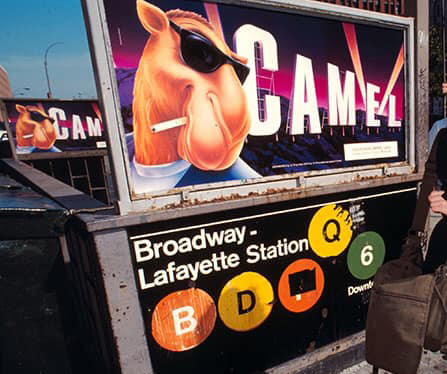
My boss at Camel, advertising mastermind MZ, demanded many versions of an ad. You did not just make one layout. If you did, you’d be fired. You made many layouts and needed to be prepared to make variations of them.
Prior to the computer, presentation boards were used with many overlays, flaps, and type silkscreened on transparent film, so that variations of the same idea could be shown. The department used incredible amounts of photostating as art directors would order various sizes of the same art that they could use to compose into these boards. Dedicated typographers designed headlines and taglines working in conjunction with the art directors. Expert layout and paste up artists also assisted the art director to physically compose a complex board.
The computer blew all of that away. We made thousands and thousands of Joe Camel ads on the computer. Some individual ads could have several hundred layout variations alone. By 1992 or so, I was a top designer of Camel national ads: billboards, print ads, phone booth posters and the like.
Sorry for the long set up, but my point is about public perception, conventional wisdom, urban legend, and pop folklore. I can see the Joe Camel drawing the same as anyone else. It’s fairly obvious that his nose looks like a penis. This is public knowledge. Even though these ads were outlawed decades ago, people still know that Joe Camel’s face was a penis.
Now layered on top of this, or behind, is the urban legend that the Camel pack had subliminal drawings on it, like a naked man, or the word “quality.” It is my observation that the owners of Camel, the RJ Reynolds Corporation, didn’t mind at all about these urban legends. The mysteries of the Camel pack was a common topic of conversation and made it into the marketing.
We worked crazy hours at Camel. Many nights until after midnight, 2 am, 4 am, even the not-so occasional all-nighter. One such late night, we finally saw it, the true face of Joe Camel. Joe Camel’s nose is indeed a penis, but his mouth is a vagina.
Yes, I said that.
A vagina with a cigarette sticking out of it. Once you see it it’s impossible to unsee. Now, no one told us this, it was our own observation, the observation of the creative team paid to make Joe Camel ads. We laughed so hard our stomachs hurt, and still laugh about it to this day.
Occasionally, even now in the 2020s, the subject of Joe Camel comes up, and the general public pretty much still knows, and you can still hear outrage, that his nose is a penis. No one talks about, or even knows that his mouth is a vagina. Hidden in plain sight for decades. Hilarious!
Now for those who think all big advertising has subliminal messages in it everywhere, I think I have to disappoint you. There are almost no top-down, management-level plans or conspiracies to put subliminal messages into ads.
I’m not saying it never happened, but it’s rare. Consider the reality of the advertising business—chaotic! Most ads are produced under tight schedules. Yes, you had months to develop an ad campaign, but 48 hours before the deadline, the client wanted something else. It was hard just to keep a coherent liminal brand narrative, forget trying subliminal.
But at the illustrator and layout artist level, the late-night crew level, stuff like this does occasionally happen.
We did put some jokes into Camel layouts. In one drawing I made a clock at the time 3:33, a 666 joke. Another time we had the Camel drummer trying to start a fire by rubbing his drum sticks together, drawn in such a way that the sticks made an inverted cross. Both of these had limited public runs, if at all and then I think mostly on match books, and were printed so small the jokes weren’t even really viewable.
The point is–yes, sometimes people work jokes, or subliminal material into ads or publications, or whatever—not as some grand conspiracy, but as the late-night joke of the hands-on workers.
And the second point is that the public can get itself worked into a frenzy, or at least possess “common knowledge” or “conventional wisdom” that is completely wrong–or at least, not all correct.
 The Only Time Richard Got Angry at Me
Leave a comment